Immunology Course 2023
12 Dec 2023
Day 2 · Innate Immunity: PRRs and Cytokines
Session 2: Prof. Carla Rothlin, Yale School of Medicine
Innate Immunity:
Structure Based Recognition
- Case: DNA - Pattern-Based Recognition:
- DNA is generally in the nucleus.
- Foreign DNA in the cytoplasm activates CGAS (Cyclic GMP AMP Synthase), which recognizes foreign DNA, produces c-GAMP (messenger), activates STING, and eliminates the foreign DNA.
- Case: RNA:
- Strategies:
- Phagolysome (receptors activated at acidic pH):
- TLR-3 (dsRNA), TLR-7 (ssRNA), TLR-9 (DNA).
- RNA from virus into cytoplasm:
- Sensors like RIR-I and MDA-5.
- Human messenger RNA (mRNA) has a cap, distinguishing it from foreign RNA.
- MDA-5 can recognize double-stranded RNA.
- Phagolysome (receptors activated at acidic pH):
- Strategies:
- Sensors: NOD I/II:
- Recognize peptidoglycan.
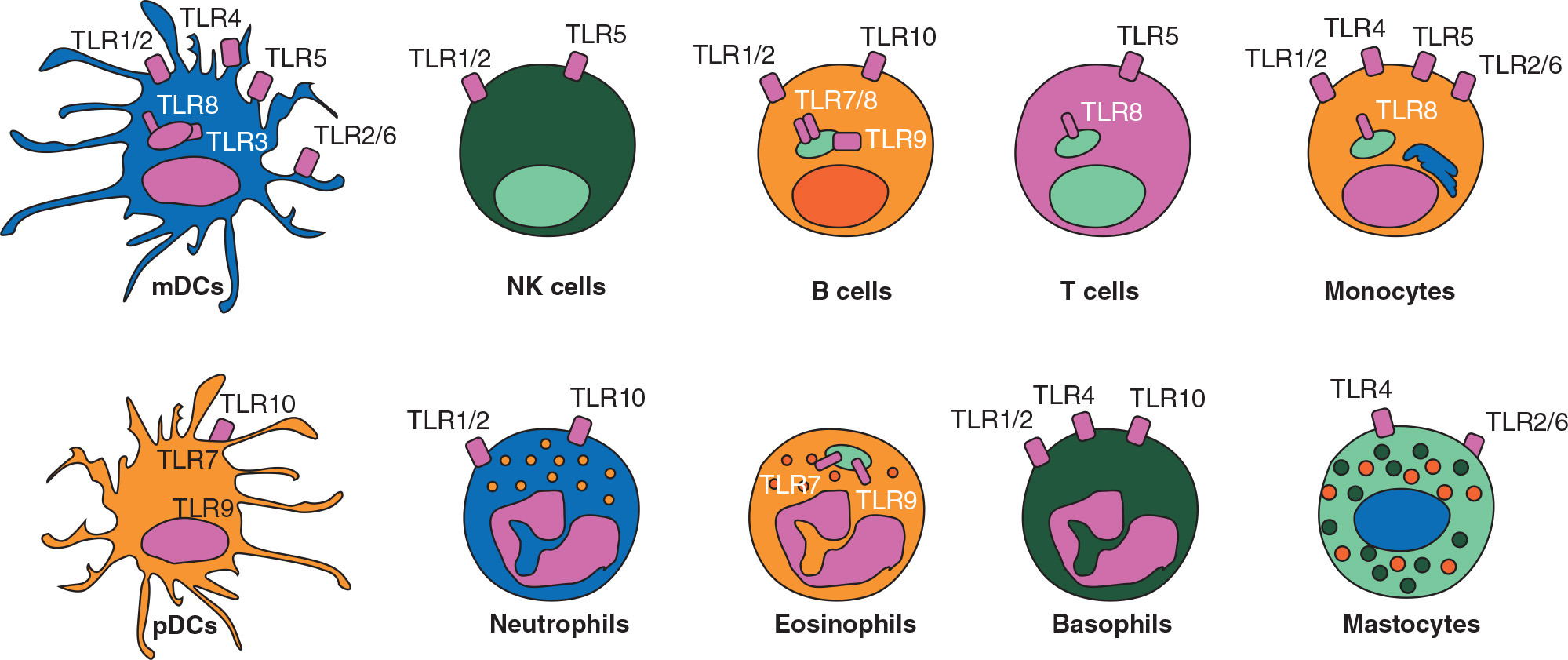 Pattern Recognition Receptors of various cells source: https://doi.org/10.1093/annonc/mdx179
Recognition of Damage
- Inflammasomes:
- NLRP3 sensor detects damage, leading to assembly with ASC (an adaptor) and CASPASE-1 (enzyme).
- CASPASE-1 cleaves pro-IL-1, inducing inflammation.
- Mechanism of pro-IL-1 release needs clarification.
- Signaling Cascades:
- TLR-4 uses MyD88 adaptor → TAKI enzyme → IKK → NF(kappa)(beta) induction of inflammatory mediators.
- Dendritic Cells (Mature) → T-cells (activation).
- Inflammatory Response → Cytokines and chemokines.
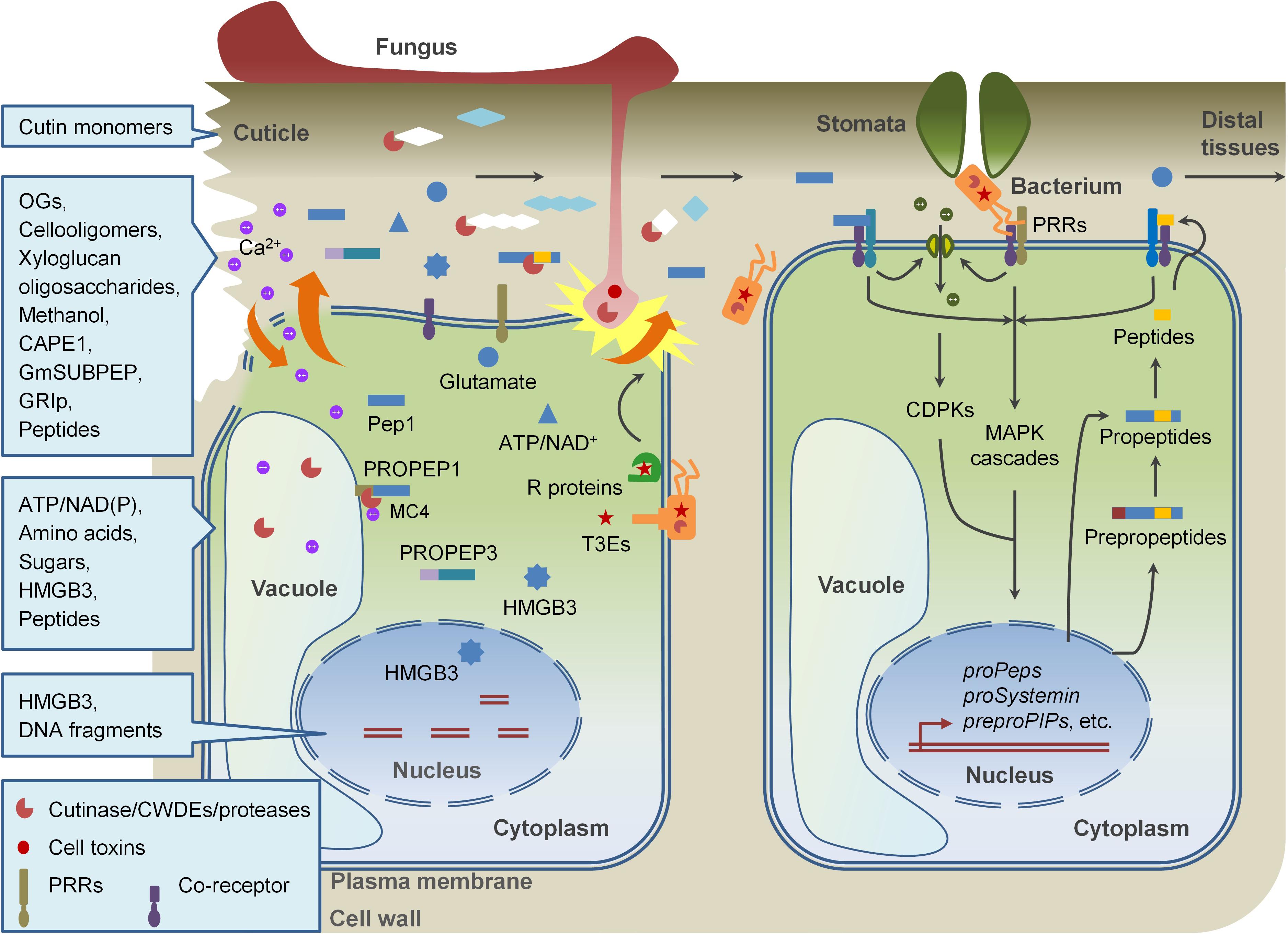 Damage associated molecular patterns source: https://doi.org/10.3389/fpls.2019.00646
Cytokines
- Type I Interferons:
- Discovered 70 years ago for interfering with viral infections.
- Induce antiviral genes via JAK-STAT pathways.
- Prevent viral replication machinery but not recommended for neurons, heart cells, or germ cells.
Group Discussion: mRNA Vaccine & Nobel Prize in Medicine 2023
- Exploring mRNA functionality, vaccine mechanisms, and addressing challenges.
Session 3: Dr. Dipyaman Ganguly, IISER
Me or not Me: Towards a Standard Model for Cellular Immunology
- Standard model evolution: Self vs. non-self, central tolerance, exceptions.
- Evolutionary necessity of an immune system: Understanding self and not self.
- Various models’ limitations: self-nonself, immune system reactions to infectious entities, exceptions in graft rejections, and pregnancy.
Danger Model: Poly Matzoinger
- Focuses on harm-causing entities regardless of origin but lacks explanation for NK cell behavior.
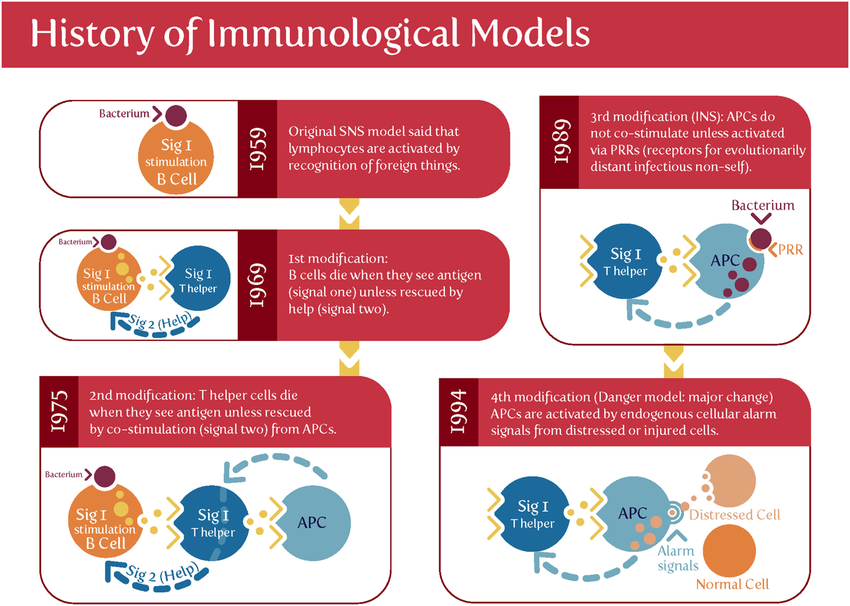 History of Immune Models source: Matzinger’s “danger model” vs. the classical theory of self vs. self-nonself
Antigenic Discontinuity Theory by Thosma Pradeu and Eruc Viver (2013)
- Suggests NK cell reaction to cellular changes.
Evolution
- Evolution’s role in the emergence of multicellular organisms and the necessity of an immune system to counter defectors.
- Multicellular organismality and ethical aspects.
Cancer Immunity Cycle
- Highlights the deviation in cancer cells from standard cellular functionalities.
Metaflammation & Alzheimer’s
- Links between cellular dysfunctions and related health issues.
Autoimmunity
- Conflicts and cues leading to autoimmunity.
Talk-4: Dr. Vinitha
How to Read Research Papers
What is Science?
- A system of acquiring knowledge and its accumulation.
- Everyday science: mundane tasks to complex research.
What is Technology?
- Systematic treatment of art and its practical application.
Paper: Vaccine Treatment of Splenomegaly in Chronic Malaria by BE Ingram Johnson LRCP Ed (15th Aug 1925)
- First report on malaria vaccine.
-
Critique on methodological apparatus: lack of control, missing references, and interpretations.
- Consideration of premunition (balanced immunity) and the Hayflick limit in analyzing the results.
- WHO approval of the malaria vaccine in 2021.
Research, report findings, and publish!